
Table Of Content
Dogs may be the most perfect creatures ever to grace the earth. They are protective yet gentle. They can be independent, yet loyal. They can be goofy yet possess great intellect for certain things. Most importantly, they create bonds with us humans that last their entire lifetime and stick with us through ours.
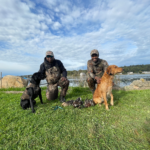
As a consummate outdoorsman, I am interested in dog breeds that can participate in outdoor activities with me. As such, I have a golden retriever named Knox who functions as a waterfowl and upland bird dog. However, given how much he loves the water and the fact that I would rather have him with me than not, it is a no-brainer to take him on my fishing adventures.
Starting with the Basics
Knox has a great foundation of training as a result of the need for discipline in the field, but that doesn’t automatically make him the perfect fishing dog. Although we would all like our dogs to be perfectly steady, they all break, especially the young ones. Training your dog does not happen overnight, let alone training them to be a good fishing dog.
Knox is rock solid with four basic commands – “sit, stay, heel, and here”. These four commands allow him to be a basic functioning dog with decent manners. From that foundation, I was able to attune Knox to his e-collar. He got to the point where I hardly have to use it at all. Generally, all it takes is a “beep” or two to break Knox’s attention from whatever has captured it.
After introducing the basics, I was able to teach Knox “leave it” and implement hand signals for four basic commands. “Leave it” has afforded me the luxury of telling Knox to give up on a smell that would otherwise take over his senses and force him to jump right into the honey-hole that I am fishing. Not to mention, it has stopped him from grabbing items that are less than desirable, to say the least.
Taking it to the Water
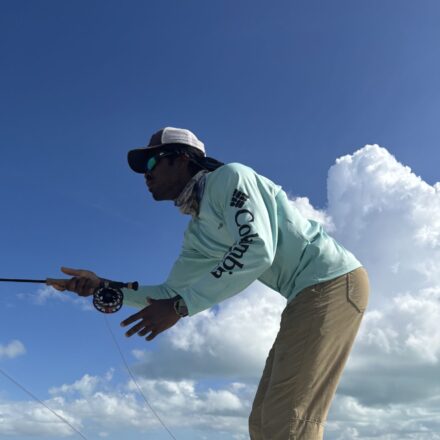
Training your dog to go fishing is not going to work if training is limited to your backyard. They need practical experience, which is where things get tricky. I started Knox out in wide open areas that gave him ample room to run and, more importantly, not disturb my fishing. I wanted to gauge his reaction to me “throwing” (casting) flies into the water. As I suspected, at first, he wanted to retrieve them. He also took an innate interest in the fly line and wanted to grab it and play with it.
My experience was unique to Knox; however, your dog may be different. This exercise in wide open areas with few people allowed me to focus on training Knox to leave my fly and keep him at a figurative arm’s length from my fly line. It took patience, but eventually he began to understand what I was asking of him.
Fishing From a Boat
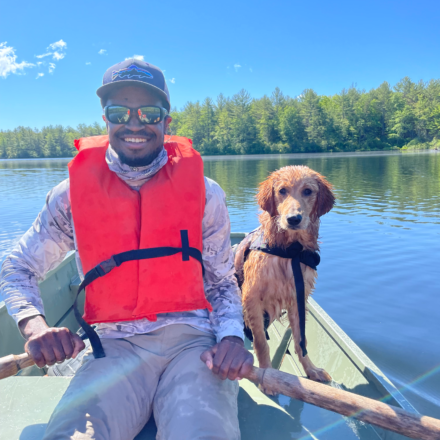
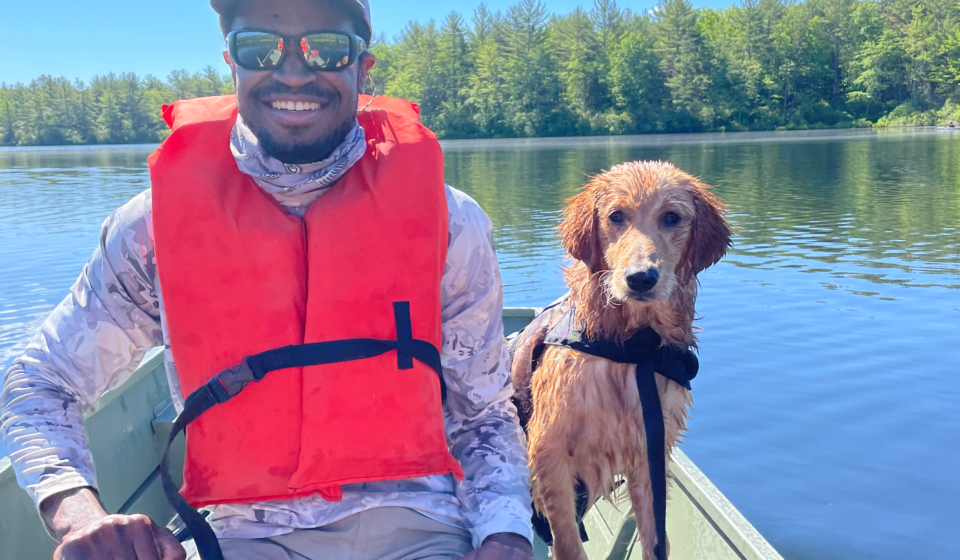
Fishing from a boat with a dog can present its own set of challenges. There is not much space for dogs to go, and this is where place training your dog can be a perfect solution. If I tell Knox “kennel” and point to a surface or area, he will go there and lie down. This is accomplished during training sessions at home by marking with a clicker when Knox goes to his dog bed and rewarding him with a treat. After a few days of this exercise, you can add whatever cue you want to use. Your dog will start to fully understand what you want after about a week of consistent training. If your dog knows how to stay, you can tell them to stay on whatever surface you have decided to place them. After another week or so and they will steadily remain in one place. Once on a boat, you can direct them to go and lie down wherever you need them to.
Safety Precautions
Knox is a fantastic swimmer and cannot get enough of the water, but he still wears a life jacket. You never know when your dog may need a little assistance from their life jacket, not to mention the top handle is invaluable. I recommend the Cabela’s Advanced Life Jacket.
Some lakes and ponds may also contain harmful algal blooms. You should know if the area you are fishing is currently experiencing one, and regardless of whether or not you check the proper channels, you should inspect the water for discoloration. Algae blooms can be incredibly harmful and even fatal to your dog, not to mention they may harm you as well. They also tend to occur during warmer months, so be safe out there during the summer.
Give Your Dog Plenty of Attention
So, you have finished training your dog to go fishing, and you are ready to hit the water. You have all the gear you need to keep them safe and have ensured that there aren’t any algae blooms in your area. There is one more thing you cannot forget. Give your dog plenty of attention out there. After all, you are presumably taking your dog with you so that they can spend more time with you. It is easy to enter the fishing zone, but at the end of the day, your dog is far more important than catching fish. Additionally, when fishing from a boat, your dog will need to be able to take potty breaks. Don’t make the mistake of forgetting about them when all they ever do is think about you.
Conclusion
Training your dog to go fishing is challenging and time-consuming, but it’s the price we pay to get our four-legged best friends out with us. I go fishing often. The last thing I want to be is a working man who also leaves my pup out of my hobbies. Knox deserves to be around me as much as possible, and I have integrated him into most aspects of my life. Train your dog to be a fishing dog, and you will not be sorry.